Doing the job twice
This week: Doing the job twice; Trees of choice;
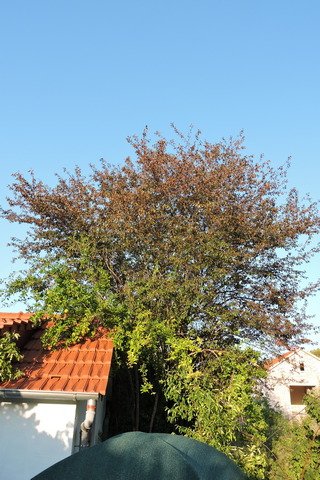
We received our rain this week, only just over 7mm, but very welcome, none the less.
However the bad news is that all my efforts last week, at waterproofing failed.
I think I was sold the wrong material, because although the package says it is waterproofing material, it seemed to be hydroscopic, absorbing the rain, not sealing the joint!
To say I was unhappy would be putting it mildly!
Around the gardens and orchards, the new grasshoppers have hatched this week. However there are some insects which are noticeable by their absence.
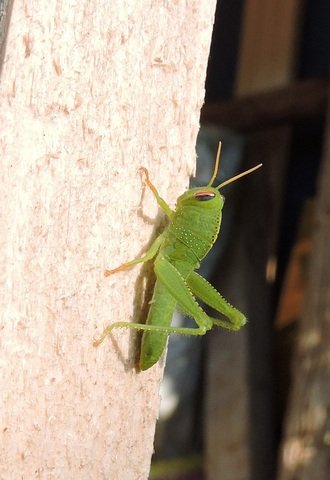
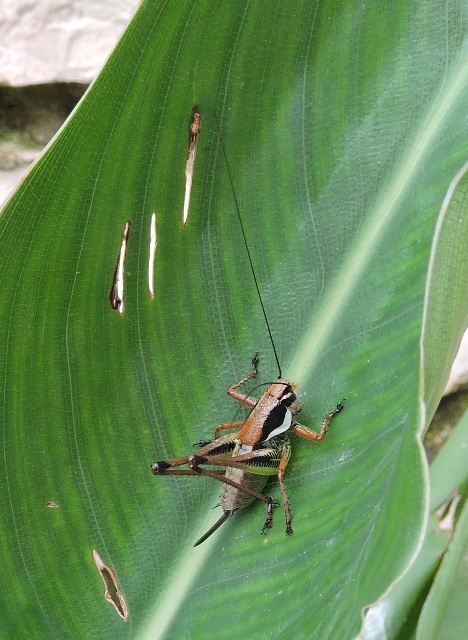
I have not seen a single Preying Mantis this year and there are no Katydid. I wonder if the winter was too wet for them?
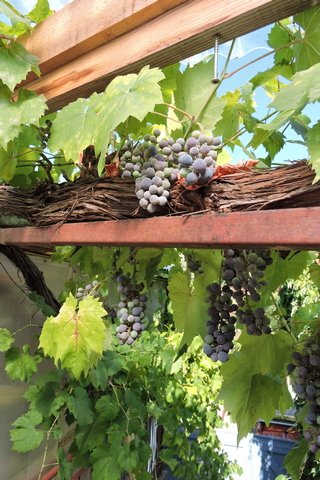
My grapes are ripening earlier than usual too. This really is an unusual year.
Our heat continues, with daily temperatures exceeding 35°C. When the temperature is coupled with high humidity, even when there is some wind, it is just not pleasant to work outside, so I don’t.
I was listening to a BBC interview with the director of the Heat Resilience Initiative at the University of Phoenix on the BBC this week.
It was about how the County of Maricopa is making the Valley of the Sun (as the area is known) more resistant to extremely high temperatures.
One comment stood out for me, “If people think it’s bad now [the heat] , it’s going to be hotter and it’s going to be hotter [for] longer. The records are going to be broken, year after year, across the world.”
That is a very sobering thought from an expert in the field. He also said that we need to move away from planning based on past experiences, and in stead plan for what is likely in 10 years time…
I looked at my summer temperatures, based on my time here in Dol and the temperatures recorded in 2026.
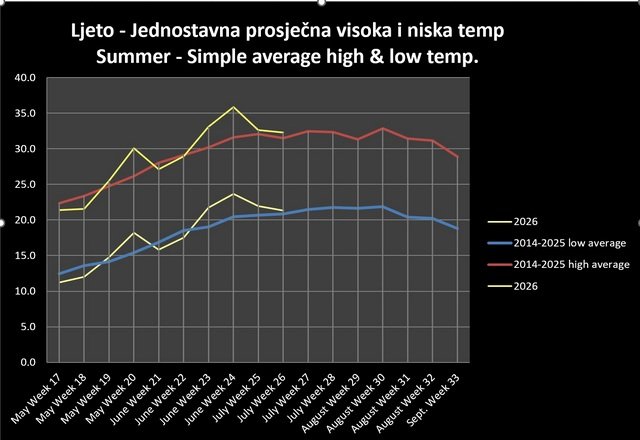
The chart doesn’t really explain how hot and unpleasant it actually feels.
As I write this just after lunch, with the windows open, the outside air temperature is 34.4°C, with a wind speed of 7 kph, 50% humidity and a heat index of 758 W/m². This gives a “temperature feel” of 37°C and it feels as though I am sitting in front of a fan-forced oven, with the door open.
This is the first year that the heat is really affecting me, however I am struggling to identify which elements are making this summer more difficult than previous years.
This heat affects weather in different ways. Summer thunderstorms are one weather event, but mostly we see them pass either to the north or south of the island leaving us with no rainfall.
This week the effects of a Supercell thunderstorm across the north of the Adriatic was felt here on the island. Supercells are the largest of earthly thunderstorms, often including very large hail and rotating winds and some spectacular wall clouds.
These storms affect sea levels and on Wednesday the storm some 300km away sent a pulse of water down the Adriatic. In the form of a Meteotsunami the wave moved up the fjord where Stari Grad lies, raising the sea level by 60cm, inundating the town, flooding properties and making tourists wade through knee deep water.
Then just as suddenly, the sea level dropped by 1.2 metres, stranding boats. We are used to flooding in the town throughout the winter and on the monthly spring and neap tides.
Property owners have defences they put across doorways when high tides are forecast, but on this occasion everyone was taken by surprise.
Climate breakdown is real and affects different areas in different ways. On the nearby island of Korčula, fires are still raging with thousands of hectares burnt to a cinder.
A fire task force of more than 20 vehicles from the north of the country were sent in to support the local fire fighters and Canadair water bombers.
Our heat usually remains until the middle of August…
Doing the job twice
I was looking forward to the rain this week, to see if my work on waterproofing concrete joints had been successful.
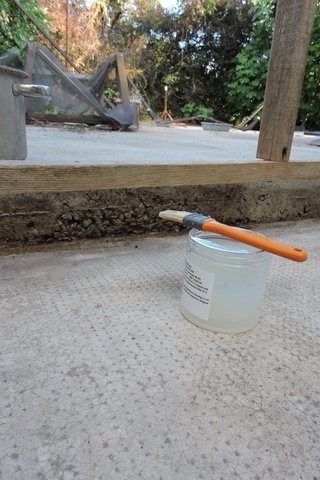
On Wednesday morning, there was just 0.5mm, enough to wet the ground, but not to do anything more. Then overnight into Thursday, thunderstorms arrived as a weather front moved through.
The island was as usual, on the edge of the storms. There was a nice light and sound show, but when I got up, my rain gauge had recorded little more than 7 mm or 7 lt/m².
However, when I looked at my work, water had leaked through to the underside of the bridge, so my intensive efforts had failed.
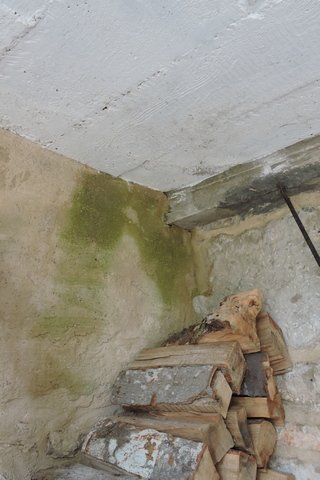
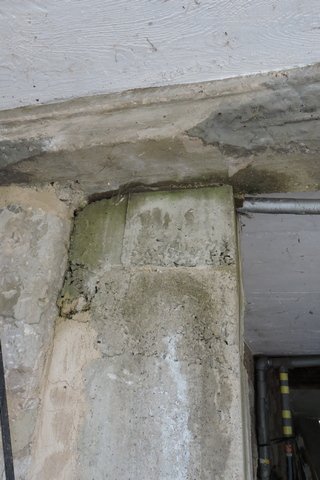
One thing which did surprise me was that the clear gloop I had applied last week seemed to be hydroscopic.
In several places I had treated, the material had swollen with moisture and had become opaque. Nothing in the instructions said that it was, but even so, it had not kept any water out.
To say I was fed up would be an understatement and I just hate having to do a job twice.
On Thursday I was back at Volat and this time came back with a rubberised paint to try again. I decided that with a smaller paintbrush, I could repaint the concrete joint, without having to undo and remove the wooden supports again. This is what I did.
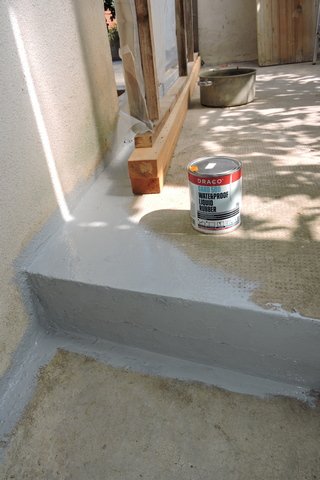
What I also noticed was that the guttering I put up to collect the rain water, was not doing a very good job.
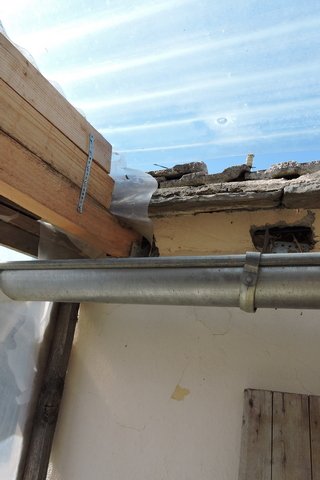
In addition, where last year I had added small pieces of polythene to keep the rain off the wooden roof timbers, this was having the effect of directing roof rain water away from the guttering too.
I need some specialist adhesive to attach polythene to the coping stones which lie under the roof tiles, to direct all the rain water run off into the guttering. Just another job for next week!
Trees of choice
I have mentioned previously that trees of the genus “Prunus” seem to really like my impoverished soils. I have discovered this by chance, not design.
In the Courtyard, where I planted a Greengage and a Shropshire Prune Damson, Prunus insititia, despite being planted into holes excavated into the sandstone bedrock, both have a lot of fruit this year.
In the spring, the damson was covered in blossom and this has translated into a lot of fruit being set.
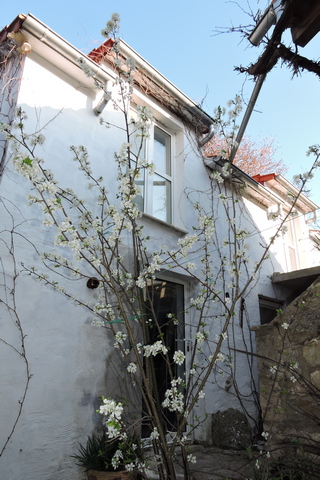
This week I have had to tie supports onto the upper branches, because I am afraid that the weight of fruit will break them, if I do not support them.
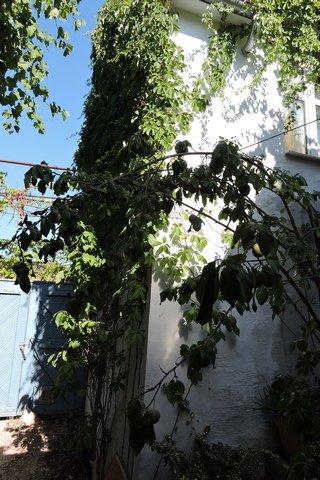
Damsons are a very old hedgerow tree. The name comes from the Latin damascenum, “plum of Damascus”, and the trees are thought to have been spread around Europe by the Romans.
My tree certainly seems to thrive on minimal water and the high heat and humidity in the courtyard.
This isn’t a “weeping” variety of tree, it is the weight of the fruits on the branches which are bending them almost double.
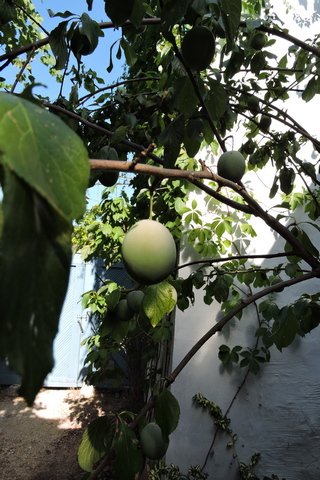
I have used canes in the past to keep the tree upright, but most canes are only 1.5 metres long, so there is a definite limit to how high you can go before the rigidity decreases.
Beginning the project, I started to make a support using a 4 metre 5 x 3 wooden lat, but found it was too flexible except when using the 5 cm edge towards the tree.
However even wide edge on, a four metre length is still too flexible. I need to put more thought into how I am going to support the fruiting branches, however as the fruit swell, I need to solve this PDQ… NCG