Break out the NATO sweater
This week: Home for a Sivi Ćuk; More orchids; Wild flowers;
This has been a week of two halves!
At the beginning of the week, there was warm sunshine. It was tee-shirt weather and felt completely spring like. Then on Wednesday it changed.
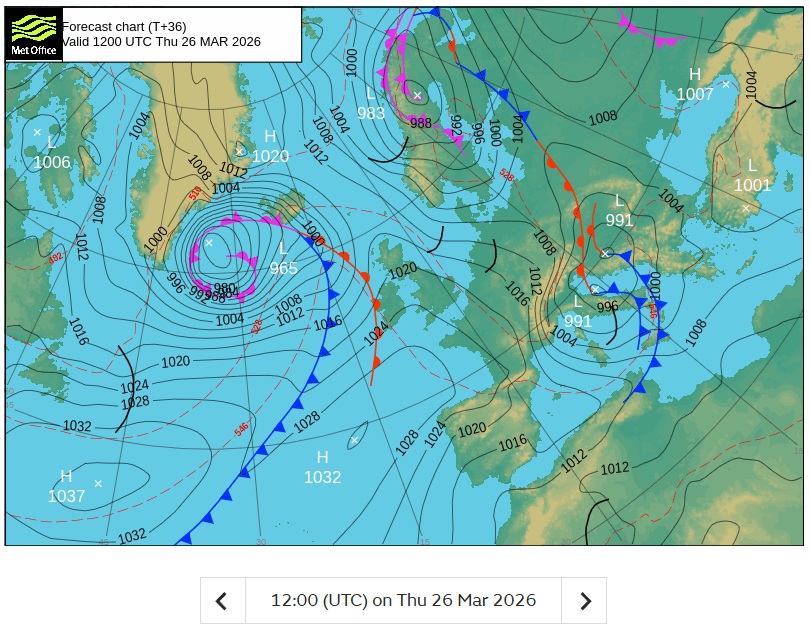
Once again the fractured Jetstream began to funnel cold air down over Europe and a complex system of weather fronts threw us back into winter.
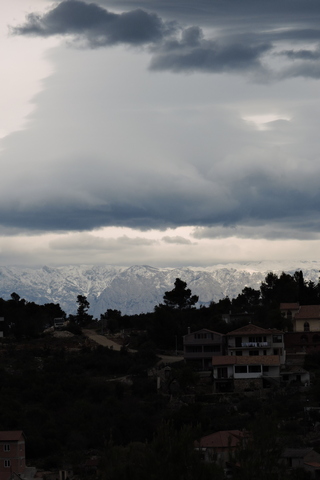
On the mainland, there was a late covering of snow on the Dinaric Alps and I felt cold… Really cold.
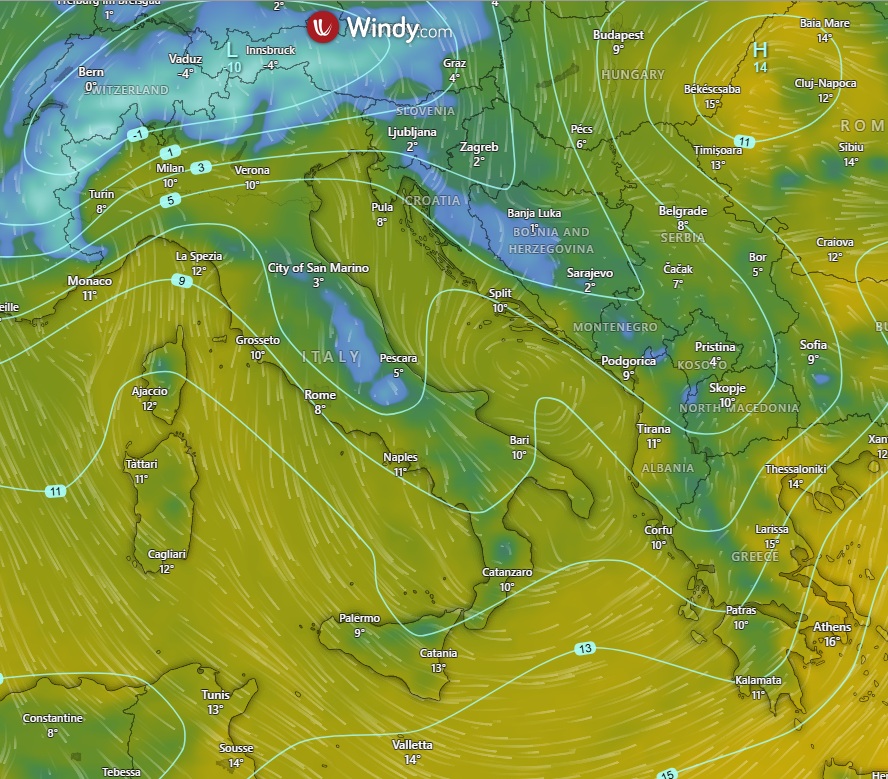
So cold that I brought out my thick NATO sweater to wear. I had thought that I had put it away until next winter. WRONG!
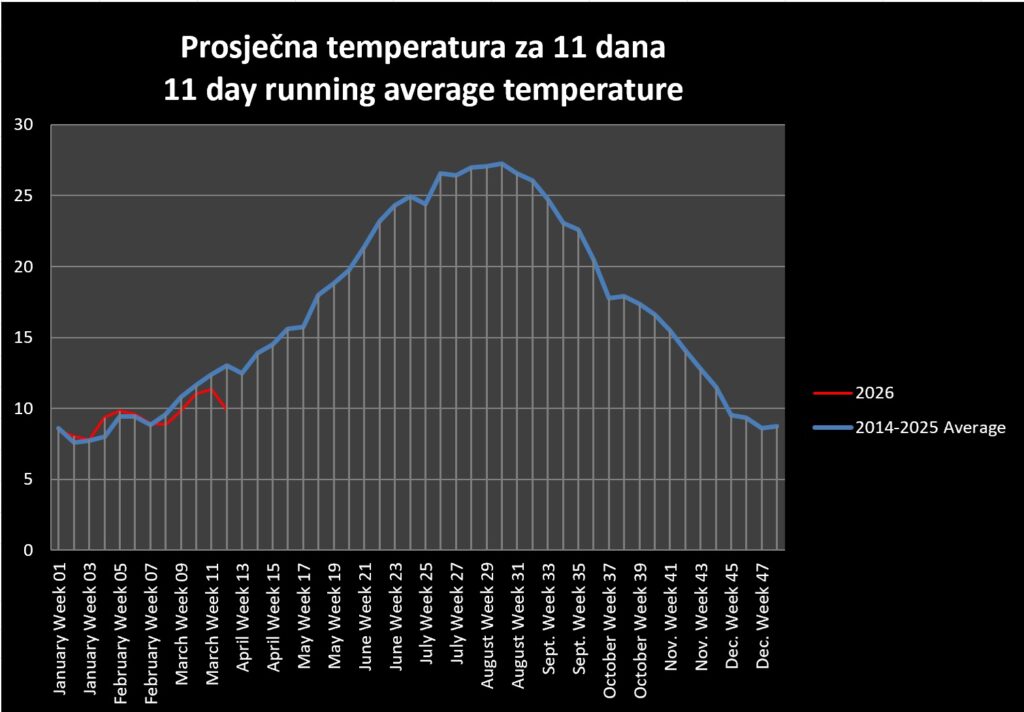
When I look at the data from my weather station, we are below the long term average, but not by a huge amount. Rather it is the bitter northerly wind which makes it feel cold.
I actually lit the wood stove on Friday evening for the central heating. The last time I had lit the fire was at the start of the month, on the 4th March.
The forecast for the next ten days is continuing cold weather, with a bitter northerly wind, so Easter looks as though it will be cold…
In the sunshine it can be pleasant, so when I was working in the polytunnel this week, the temperature was over 20°C. Warmth plus moisture equals explosive growth of weeds.
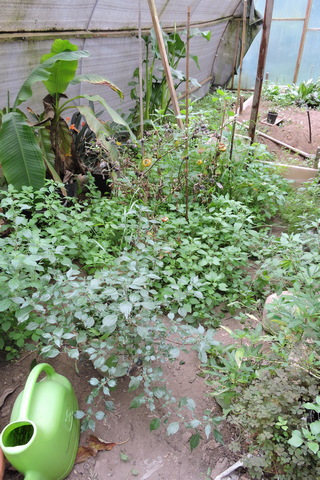
I had left them until the were large enough to easily remove by hand, but not so large that I needed a fork to dig out the roots.
Almost all the weeds are Pellitory of the Wall, Parietaria Judaica, a plant which thrives here in Dol. The flowers were just beginning to show, so I was able to remove them before they set seed.
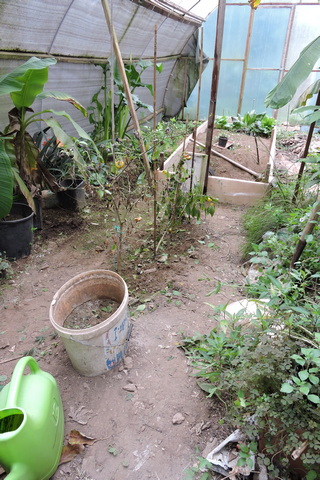
It is a perennial in the Mediterranean, so I know that I have only “bought some time”, before the next lot of seeds germinate.
There is still more work to do in the polytunnel, so I am hoping for a little sunshine this week, to make working in there far more preferable to working in the wind, in the orchards.
This week, the late blossoming trees, like my Shropshire Damson, Victoria Plum and some sweet cherries have all reached peak blossom.
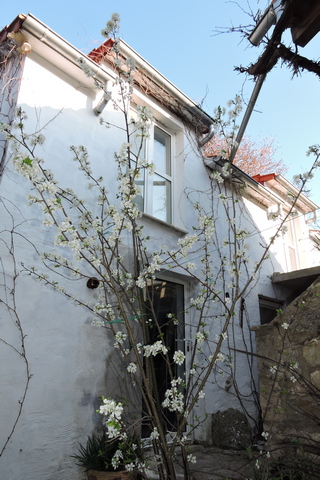
My concern is that with a cold wind, not all the blossom will set fruit. This week’s night time temperatures of around 6°C, is really at the low end for successful fruit setting.
Sweet cherries in particular are susceptible to cold, which is a shame, because there is more blossom this year than I have ever had before. I do like cherries and they are expensive in the shops.
Tonight the clocks go forward by one hour at 02:00, onto Central European Summer Time, CEST. So there is one hour less in bed and from tomorrow, the evenings will be longer as sunset will be at 19:15.
Home for a Sivi Ćuk
At dusk on Wednesday I was listening to the chorus of birds from all around my home.
Earlier in the day I watched one of the Kestrel Hawks, Falco tinnunculus (HR: vjetruša) calling from the tall pine tree behind my home. He has been absent for most of the winter but with a mate nested and raised a brood of four chicks last year.

With all this avian activity, I have been thinking about the owl nesting boxes I want to build and install.
Every year I have a “Little Owl” Athene noctua, around my home. This diminutive bird has a distinctive high pitched squeaking call and on warm summer nights I see him/her sitting on the electric wire hunting.
He darts away and then returns with some food. I am certain they are nesting nearby, but have never discovered where.
The birds are highly territorial and once they have settled in an area, will remain for life.
Reading up on their nesting requirements, they like hollow trees, with completely dark interiors. Where there are none, they nest in old buildings, hollows or old ground burrows.
One requirement is for a dark “corridor” at the entrance to the nest. Helpfully, there are plans on the internet.
As nesting season is from April and May, I started building a nest box for a Sivi Ćuk, the Croatian name for the Little Owl.
I had some waterproof plywood offcuts left over from an other project, so made use of these to fabricate a 30cm x 40cm box, with the required dark entrance.
The panels have been left outside but undercover, so have gathered a weathered patina which I hope will make the box of interest to a pair of Little Owls.
I had thought last year about getting a “nest camera” but didn’t do anything about it. Now I need to research what ‘nest cams’ are available, so I can install one later in the year.
Little Owls only lay a single clutch of eggs, so it is too late for this year, but it would be nice to have a camera for future years.
After cutting the last of the pieces for the nest box with a jig, so the circular saw made perfect right angle joints, I fitted the base and the roof.
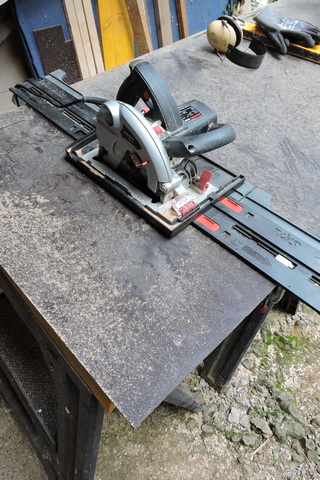
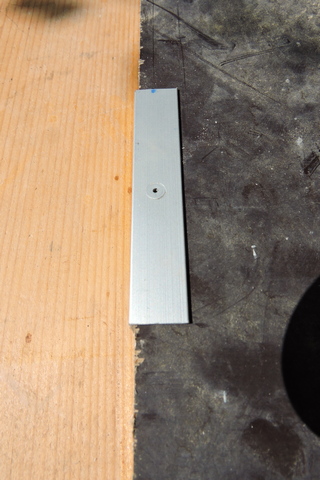
I made a small tool out of aluminium, to exactly centre screw holes in the cut panels.
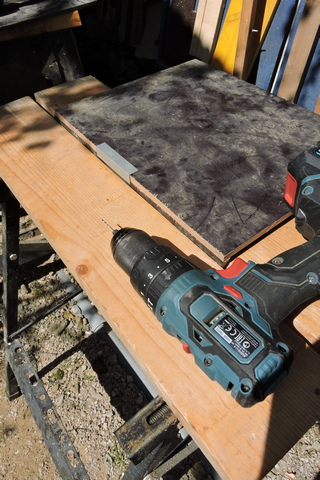
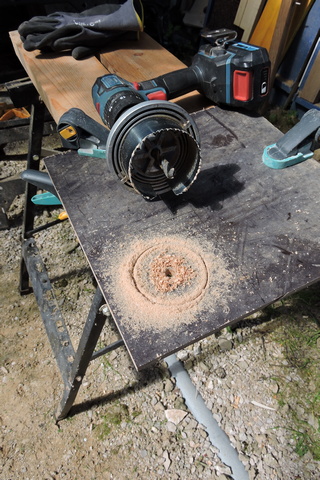
Another task was to cut at 70mm diameter hole for the owls to use.
The panels have been assembled with stainless steel screws. I needed to go to Volat on Saturday morning to get the hinges for the lid.
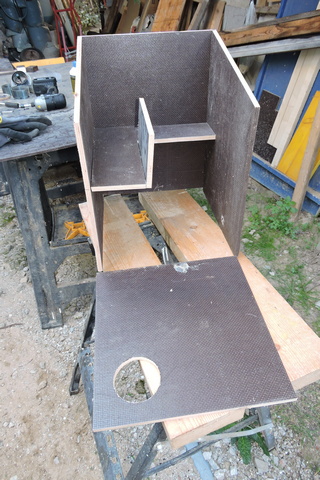
Little Owls are undemanding when it comes to nesting material, needing only some dry sand with perhaps some wood shavings so they can make a “scrape” to lay their eggs in.
Owls have a very poor sense of smell, so new shavings will not put them off. I still have work to do, but the current cold means I have not seen any likely tennants flying around my home…
More orchids
I have continued my walks through the Maquis this week. At least, early in the week when the weather was good!
The early Spider orchids are still all there and are starting to die off, presumable having had their flowers pollinated.
I was looking for the first of the Bee Orchids, but didn’t actually see any. Not even any of their leaf rosettes.
But What I did finds was two shoots of the Violet Birds Nest Orchid, Limodorum abortivum.
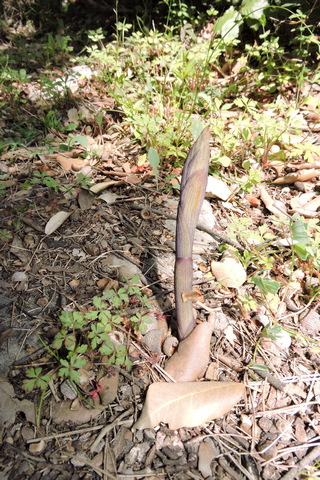
This is a rare orchid with an unusual life. It spends eight to ten years underground, in high alkaline soils and under the canopy of the Maquis.
The shoots are a dark, thick and resemble an Asparagus spear. Leaves are sheathed along the stem and look like scales as the shoot emerges. The plant has almost no measurable chlorophyll, which is why is appears so dark.
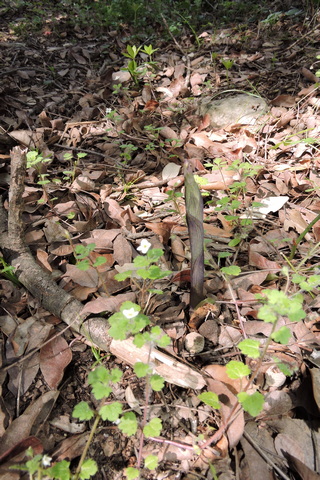
Chlorophyll is what makes leaves green and supports plant photosynthesis. Without it, plants do not make food.
This orchid is parasitic, obtaining all its food while underground, from fungi, using the Wood Wide Web to feed.
There is just a single spot where these orchids grow and in previous years I have seen a maximum of eight flower spikes. I extended my search this week to other nearby areas with the same soil and tree species. However I could not find any more shoots.
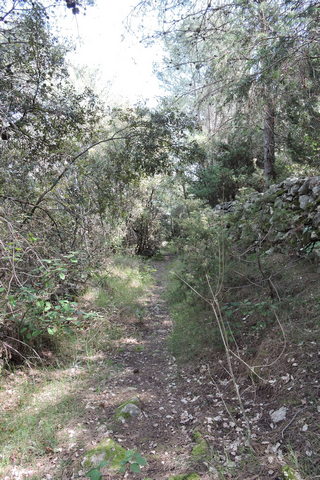
So I presume there is just one single location, in the area that I monitor, where they grow. I will continue looking for more shoots and of course wait for the actual orchid flowers to appear.
Wild flowers
Visitors travel to the Mediterranean islands for a host of different reasons.
In summer it is for the warm sea and hot sunshine. However, in Autumn, it is because of the abundant olive and wine tasting, paired with local cheeses of course.
In winter, it is because they own property and want to visit when things are quiet.
But in spring? well one reason could be the wild flowers. I had three felines with me on this particular walk and they like to stop and investigate the smells of the flowers we pass. There are times when I am sure they think they are dogs…
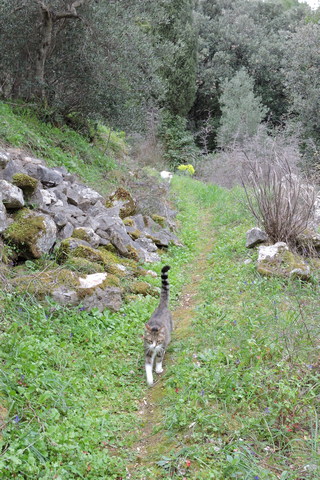
This week when I was taking a short cut through an olive grove, I was taken by the abundant carpet of wild flowers under the trees.
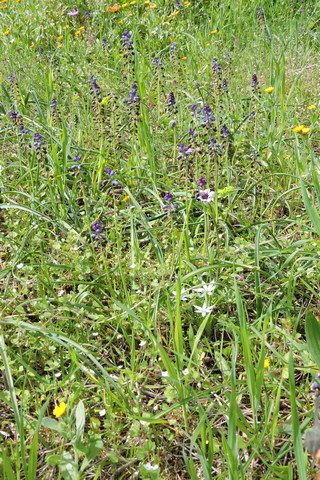
In a few short weeks, when the soils have dried and the ground has cracked, all this will just be dried grass, brown and uninteresting.
However this week, there are wild flowers everywhere, on every path, in every roadside verge and of course in our orchards and olive groves.
In the sunshine, this Broad Leaved Anemone positively glowed. It is Anemone hortensis, a wild flower endemic to the Mediterranean basin and named by the Greeks, two millennia ago.
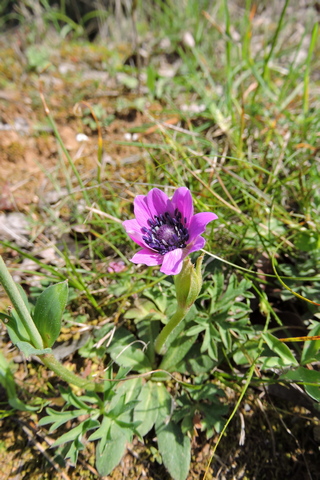
With subtle variations in their striking mauve flowers, their flower heads dance in the wind from the South of France to the Levant, attracting pollinators.
A little further along, I watched a pair of Eastern Dappled White butterflies, Euchloe ausonia, going through their mating rituals and alighting on bright yellow Hawkbit flowers, Leontodon tuberosus, to feed on nectar.
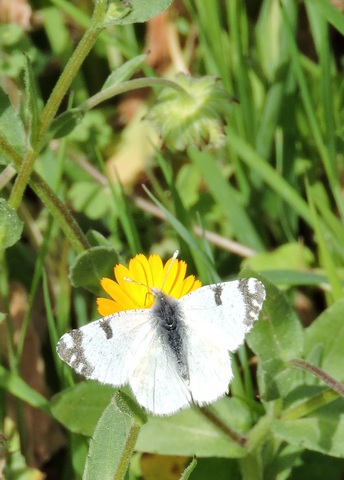
On some Greek islands, the root tubers and leaves of Hawkbit are eaten.
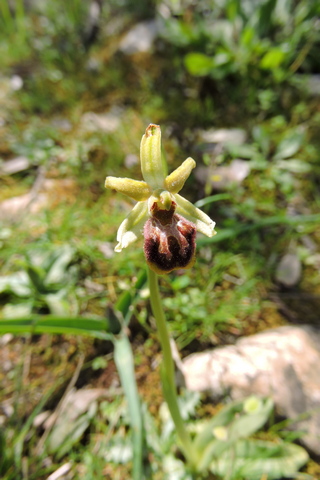
And of course the orchids are still to be seen, here another Early Spider Orchid, but only the really observant see them.
Despite the cold and rain – on this late Saturday afternoon, I’ve just been to make a hot drink and it is barely 8°C outside – Spring is my favourite times of year. NCG