Ideas over coffee
This week: Orchid hunting; Ideas over coffee; The window seat;
It has been a bit of a “plant” week, this week.
I had a Callistemon bush which has been in a large ceramic planter for years. It has outgrown the pot and become root-bound. This was the reason I wanted to move it into a permanent site in the Top Orchard.
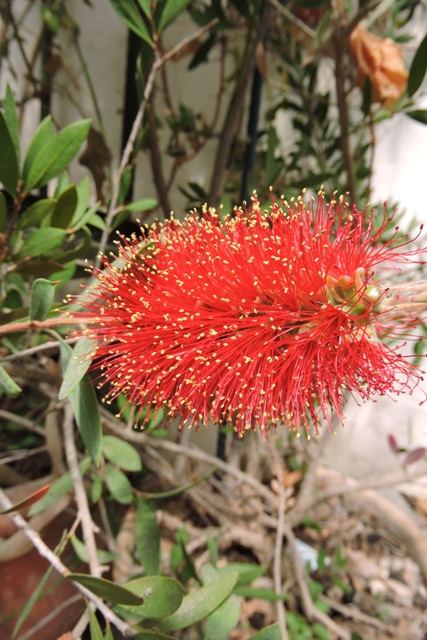
Getting it out of its pot was hard. Being porous the roots had started to bind into the pot, so after trying to pull the shrub out, and failing, I soaked the roots for 24 hours.
That failed and despite my best efforts, I couldn’t budge the shrub. I had to use a hacksaw blade around the edge of the planter to cut the small roots. Once this was done, I was able to pull the shrub and a very compacted root system out into the fresh air.
I had prepared a planting area, cleared the grass and weeds and dug a hole, so I planted it and then watered the shrub in. I’m hoping that it will take and thrive in the rich soil of this orchard.
At the other end, in the East Orchard, I spotted a flower I hadn’t seen before.
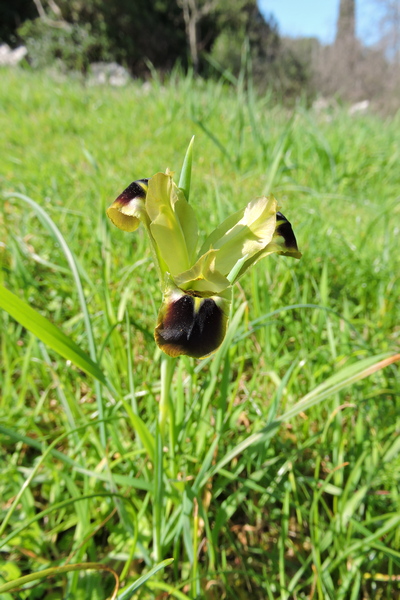
When I looked in the orchard, I thought at first that it was an orchid, because of the black fall. However there was something about the flower which made me think not and it was vaguely like an Iris.
With the photographs, I did a Google reverse image search and immediately came up with the answer. It is Iris hermodactylus tuberosus, the Snake Head Iris.
This is a Mediterranean native wild flower which grows from a tuber. The striking three black falls of each flower head, are really unusual, because the other falls of each flower are a vivid green. The colours mean that the flowers readily blend into the grass.
Still in the orchards, I had two Japanese Acer shrubs in the Top Orchard border. However whilst one is thriving, the second has died. So this week when I was at the Plodine supermarket, I was surprised to see a tray of small Acers for sale for €4.19 each.
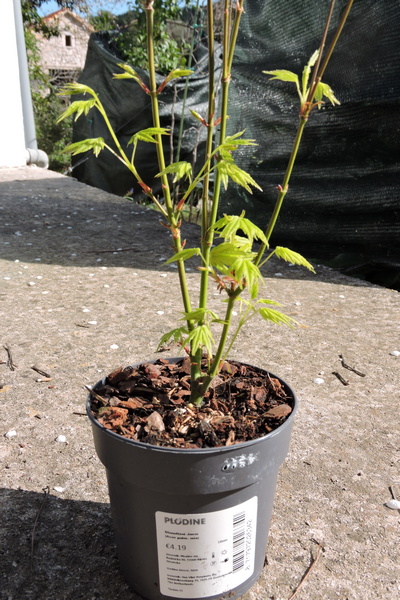
I came home with an Acer palmatum “Going Green”. It is small, only standing 10cm tall, so I will pot it into a larger pot and allow it to grow in controlled conditions for perhaps two years, before planting it out into its final border location.
Other plantings included putting some raspberry canes into their final locations.
Over several years I have tried different varieties of Raspberry, however with the exception of one, none could survive the summer heat and lack of rain. The exception is a variety of black raspberry.
They readily root, even in my worked out soils, so last autumn I dug up a number of canes. As they have started to show leaves, it was time to move them from their temporary winter planters into a permanent position.
Then there were some blackberry plants, also in pots, which I planted out into the East Orchard.
Also showing the first leaves this week is my old grape vine.
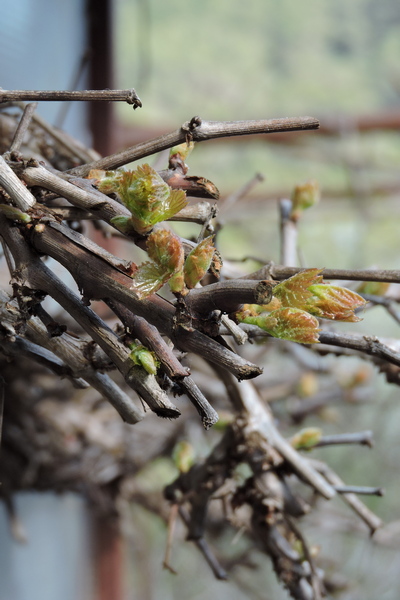
On Tuesday morning, while I was trying (and failing) to remove my Callistemon from its pot, I heard the first Nightingale of the year.
This is the first of our summer visitors and it was singing its heart out from the coppice on the edge of the orchard.
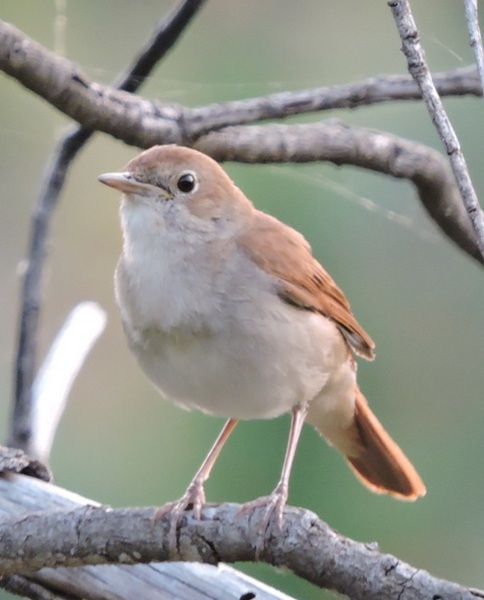
I am fairly certain it is a regular visitor to the orchard, at least as certain as I can be when they are not ringed. There has been a Nightingale calling from this coppice for the last three years.
Nightingales are ground or thicket nesting but sadly only have a lifespan of three or four years, so I will be watching for fledgelings.
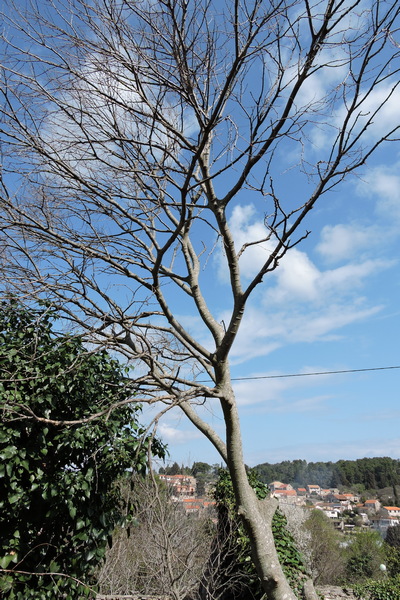
I’ve cut more of my “weed tree” down this week.
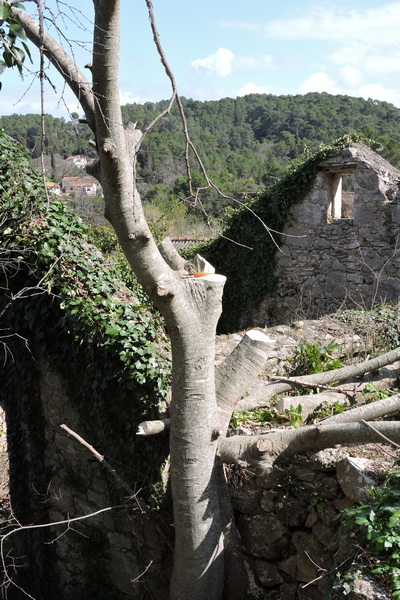
There is now just one more limb to remove. It is the largest and is leaning the “wrong” way, so I really have to think about how I make the cuts so it falls where I want it to.
Orchid hunting
While parts of the northern hemisphere are still under snow and cold, as yet another thrash of the Jetstream drags Arctic cold down into North America and northern Europe, here in the central Mediterranean we are well into spring.
This is the time of year when the first orchids begin to appear.
Along the old donkey track which forms the southern boundary of my property, I have been surveying the flora and fauna for a number of years and spring is when I start the survey each year. This is when the natural world wakes up after its winter slumber.
Following my hospitalisation three months ago, walking is one of the recuperative therapies, so I have been walking and checking the 500 metres of path which I monitor.
The path runs through the Maquis and varies from being completely under the pine tree canopy to open grassed areas.
There are thought to be around 30 species of orchid present on the island, each with its own highly specific growing requirements.
There is one part of the path, fully under pine trees, where the Violet Bird’s Nest Orchid, Limodorum abortivum, grow.
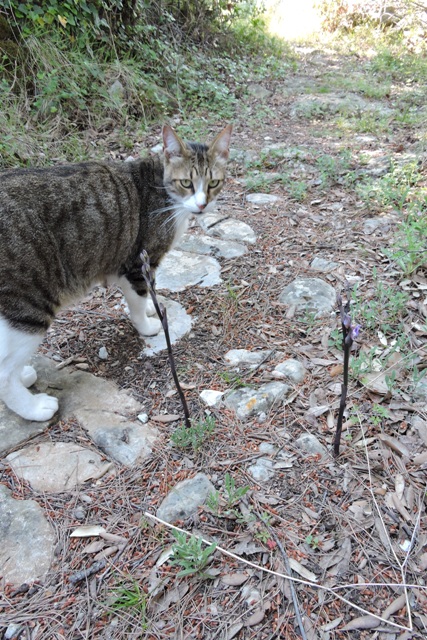
This orchid alone has a unique life. Each plant spends eight to ten years completely underground and invisible growing as a rhizome, in alkaline soil, feeding using fungi in a parasitic relationship with the trees, known as Mycoheterotrophy. The plant flowers just once, sets seed and then dies.
Continuing along the path, I found several leaf clusters where the orchid flower is yet to appear.
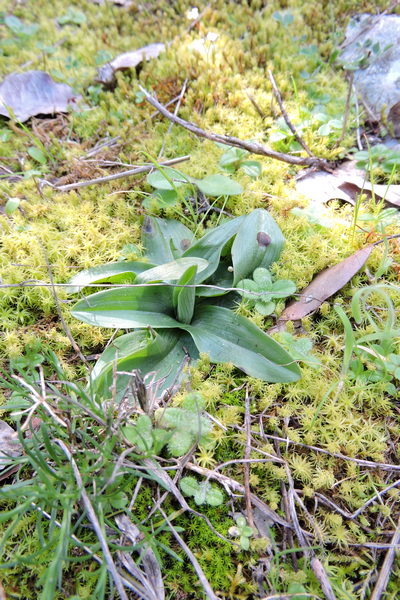
Whilst it is possible to identify an orchid from a weed by the leaves, sometimes, without a flower, you cannot tell what kind of orchid you are looking at.
I know there will be different orchids in flower from now until late May or even into June, however this week I was just looking to see if I could see any orchid plants.
I was delighted when on one 20 metre stretch of path, by an old stone wall, I found more than 100 flower spikes. These are the Ophrys Liburnia (also called Ophrys sphegodes) – the Early Spider Orchid.
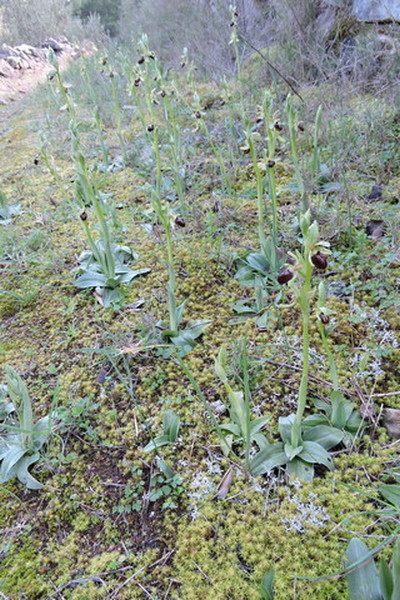
This is an early flowering orchid, first appearing in March when others are still only leaf rosettes.
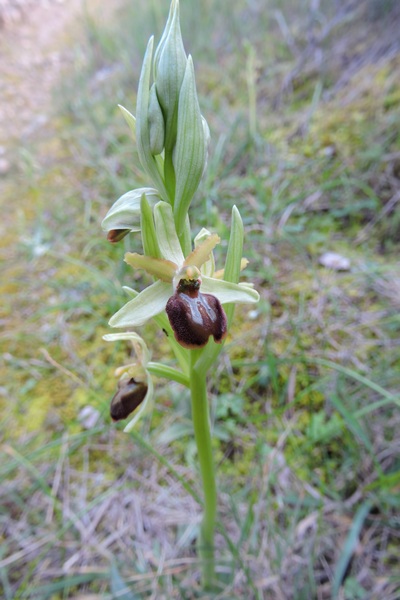
The lifespan of some orchids is very short, so I am walking each of the various paths every other day, with a keen eye, looking for orchid leaf rosettes, or even better, actual flowers.
Ideas over coffee
Over a long coffee with a friend one morning this week, I was musing about this blog and also I have wondered for some time about using either a Podcast or Vlog as an adjunct to my weekly discourse.
Blogs are about personal expression. Mine is not a diary, rather it highlights one or two aspects of my week here in Dol. It certainly doesn’t cover everything I do or don’t achieve and I tend to focus on the natural world quite a bit.
Photographs are good, but sometimes I struggle to convey the extent of something in a single photograph. Short videos do get over this problem.
Here is an example, showing the actual number of Spider Orchids I found during my survey this week.
What I only realised when I got back home and looked at the video, is that my camera doesn’t automatically change focus, so when I tried to do some closeup shots of the orchid flowers, they are out of focus.
I hadn’t intended having Tigger in the video, but he wouldn’t move out of the way!
All of the felines like going for walks with me through the Maquis, fortunately not all of them together at the same time though!
I did some reading up on-line, but really came to no firm decision either way about trying something new.
When I looked at the technical requirements, I think I have everything I need to make a Vlog. However it would only be very occasionally because the Blog format works for me and also it seems for you, dear readers.
Once again I am reminded of that dreadful American idiom. “If it aint broke, don’t fix it”. However appalling the English, it is a truism…
The window seat
I have reached the final stage of my kitchen window seat saga.
At the start of the week I finished constructing the central seat support structure. Then came a couple of coats of Sadolin on unprotected areas of wood. Once this had dried, I offered the support up to the wall to mark where I needed to drill and plug the wall.
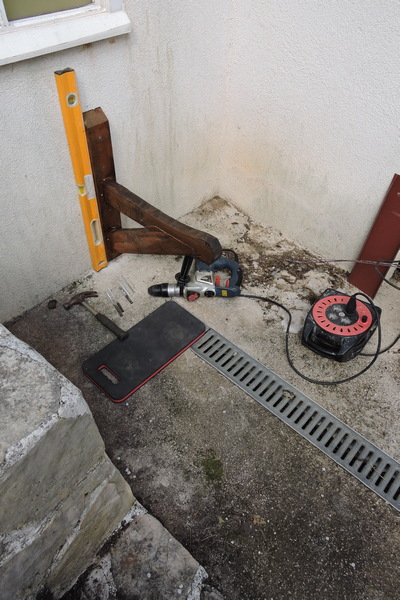
Ideally the top of the seat support should be 39cm above the floor, because the actual lats will go on top and 42cm is a comfortable seating height, so I started by marking the centre of the wall and then the height where I wanted to mount the support.
When I bought my home, this was a doorway into the kitchen. This was one of the first jobs done by Cvjetko, to block up the door and turn it into a window.
I have a range of different wall plugs, each designed for use on different wall surfaces, so to decide on the right plugs, I needed to determine the structure of the wall.
Going back through my photographs, I found that the doorway had been blocked up with hollow concrete blocks.
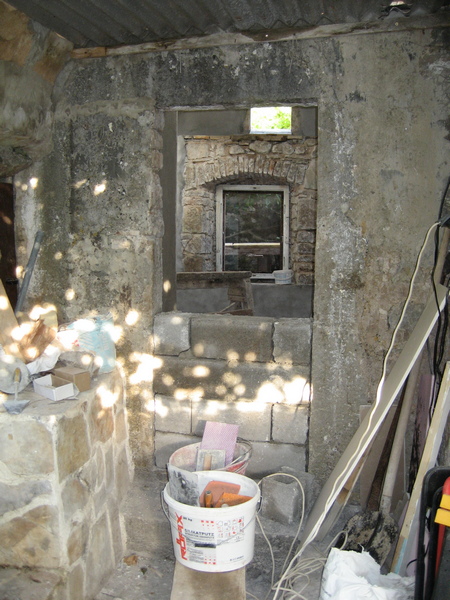
Starting with a single hole, I drilled the wall and then did a temporary fix of the support to determine where the other holes needed to be drilled.
My experience is that using SDS walls drills, you can very quickly drill a hole in the wrong place, or make a hole which is oversized.
So my practice is to start with a small diameter drill and gradually work up to the 7mm hole for the actual wall plug. I am using 100mm plugs because this support will need to hold the weight of two or even three people sitting on the seat.
With the first hole in place, I marked the location of the next three and carefully drilled them out.
Then it started to rain. After such a nice week, I wasn’t expecting rain, and hating working outside in the rain, I stopped until the rain had stopped. By then it was lunch time.
Resuming after lunch, I started marking up where the first of the side seat supports would go.
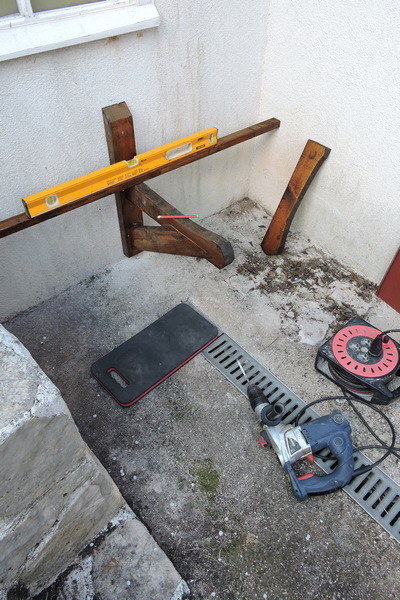
A level is one of my essential tools and in this case, with the first seat bar in place, I wanted to make sure that I would put the side bar in the right place.
Then I realised that I have not drilled them for fitting to the wall. So before I can fit them, I need to drill each bar to take the wall screws.
Thinking back, it was because I was trying to decided whether I needed two or three screws in each bar. The more I think about it, the more I think that I will use three.
Three wall screws is perhaps a bit of “overkill”, but it should ensure that even if someone stands on the seat, it will not give way.
So as the week comes to an end again, I am part way through a job which will be continued next week. NCG