Decision made
This week: Tropical Nights analysis; And for my next project; Decision made;
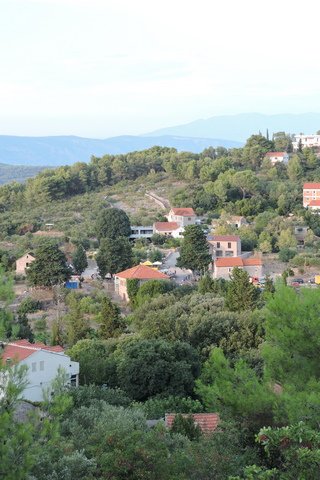
This Saturday afternoon, it is currently 37.2°C in the shade and the only sounds from outside are the Cicadas.
The heat this week has been punishing. The days have been long and hot and there has been no rain.
As I look out of the window, a line of towering Cumulonimbus clouds are hovering above the mainland and a quick check of Blitzortung shows significant thunderstorm activity along a 100 km front from Makarska to Sinj.
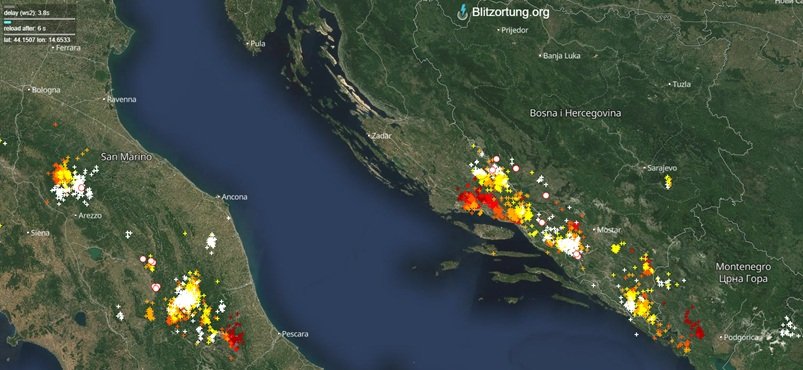
There have been storms in this area almost every day this week, but not a drop of rain on the islands. In once sense it is good, because that is where our water is piped in from, but it doesn’t help my plants and trees.
The postman called on Friday, perspiring profusely as he had a notice to deliver to every house, rather than just the odd bill or package.
We had a conversation in the shade of my courtyard about how unusual this heat is for this point in August.
August is usually hot, but the forecast is for 38°C by the middle of next week. That looks as though it will be a reality.
The felines are trying to find any shade they can and even Callie, my Abu Dhabi Arab Mau does not like this heat.
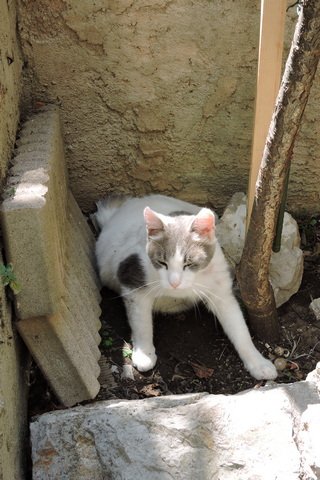
From 08:00 it is really hot and humid, and just unpleasant to be outside.
My plums are still not quite ready yet for picking. I think another week or ten days before the are ripe. Plums don’t ripen once they are removed from the tree.
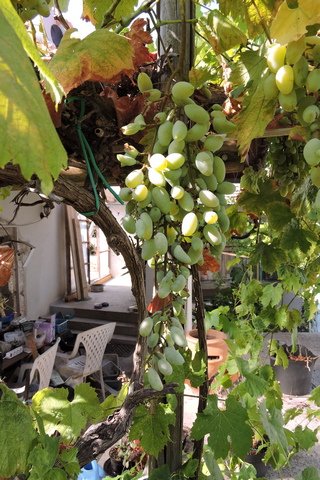
Meanwhile, my grapes are ripe enough to pick and eat, but they don’t have the sugar content of previous years.
Tonight is the last night of the village Puhiyada festival.
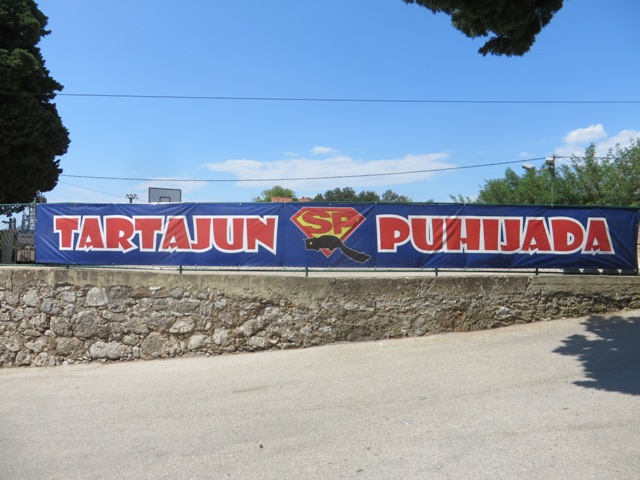
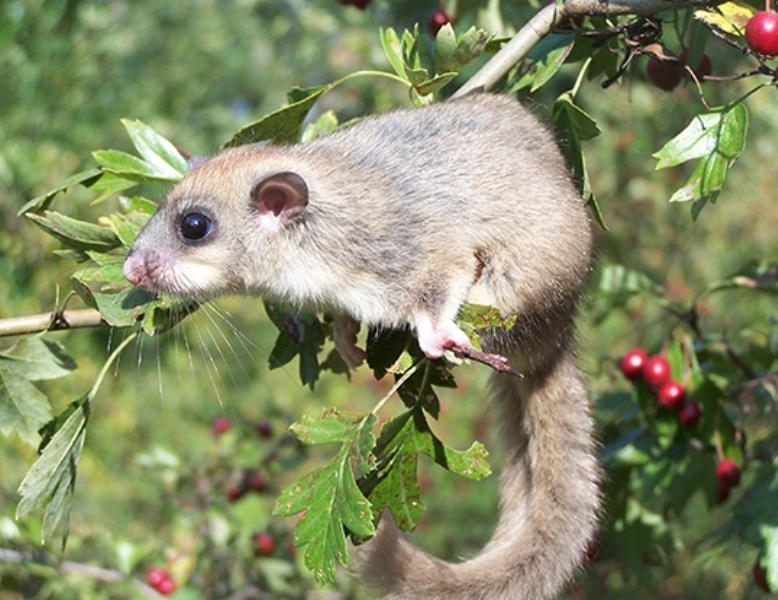
This annual event which celebrates our Puh, the cute Edible Dormice which live around my home, has been going on all week, with a Balota competition, art exhibition and tonight the finale, the grand concert.
The music, singing and dancing will go on until 04:00, so I will not be getting much sleep….
Tropical Nights analysis
On a baking afternoon this week, I started looking at my data on night time temperatures.
I have skirted around using Artificial Intelligence and/or ChatGPT, principally because I really do not have any use for AI and I don’t need ChatGPT for anything.
But the more I looked at the data I have collected, the less I could see a way of presenting it in a meaningful way. So at that point I thought I would see what AI could tell me about my data…
I had to load the spreadsheet information up to the ChatGPT engine and then asked it “How do I present this temperature data in a meaningful way?”
The AI system took around two minutes after uploading the data, to tell me the following:
Recommended Visualisations
Use a Heatmap (Year vs. Week): This is the most effective way to visualize this data. It allows you to see both seasonal patterns (columns) and annual trends (rows) at a glance. You can quickly identify “hot” weeks where values peak consistently across years.
A second choice would be a Multi-line Chart: Useful for comparing specific years to see if a particular season was an outlier.
Average Seasonal Trend: A single line chart showing the average across all years helps define the “normal” temperature cycle for the region.
Summary of Findings
Peak Period: Temperatures consistently peak between Week 25 and Week 32 (July and August).
Seasonality: The values start at zero in early May (Week 17), rise through the summer, and drop back toward zero by late September (Week 36).
Yearly Variation: Some years (like 2018-2022) show higher sustained peaks compared to earlier years in the dataset.
It then helpfully produced this chart from my data.
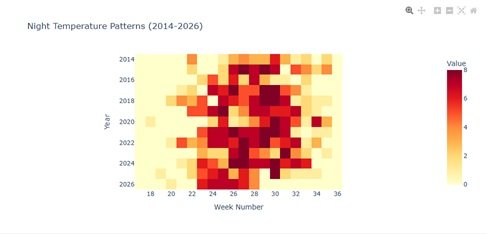
In what it calls a heat map, to me it makes the data almost unreadable. Certainly it is not easy to pick anything out from the coloured mass. Could it be a test for colour blindness even?
Thinking more about the problem, I decided to try a simple seasonal trend. This is what I do with all the graphs I produce.
I try and think about the person who is looking at the chart. I want to do the brainwork, so the reader doesn’t have to. The best charts are ones which are completely self explanatory.
A person looking at the chart can tell immediately what the data is saying. This is the result.
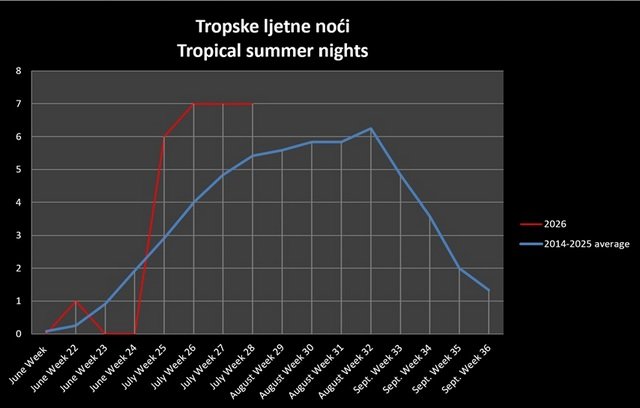
The blue line is the average, which because it is an average, is relatively smooth. It records the number of times each week a night exceeds 20°C, the international definition of a “Tropical night”.
The red line is for this year and being a whole number for that week rather than an average, is more angular. You can see that the average is 5 tropical nights a week against the seven nights we have been experiencing this summer.
As an aside, the average inside temperature in my home this past week has been 29.5°C, because I don’t have any air conditioning…
And for my next project
My attempts to rehydrate the timber top of my drill press stand have been successful and I fixed the wooden top pieces down to the stainless steel work bench this week.
I have used wide head Allen bolts through aluminium channelling, under the stainless steel work top, to really anchor the wood in place.
The next job was to position and drill 10 mm holes for the securing bolts for the actual drill press.
There are only two holes in the cast iron base, so these are probably the most important bolts of all.
The drill press is quite tall, so has a high centre of gravity, which together with the wheeled worktop I am mounting it on, means that stability may be an issue.
With the cast iron base in place, I started the assembly of the actual machine.
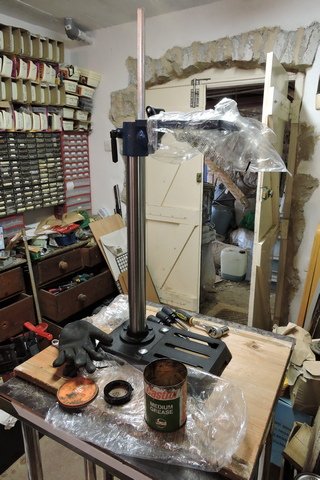
Mounting the vertical tube which holds the machine’s weight came next, followed by the platen where work goes.
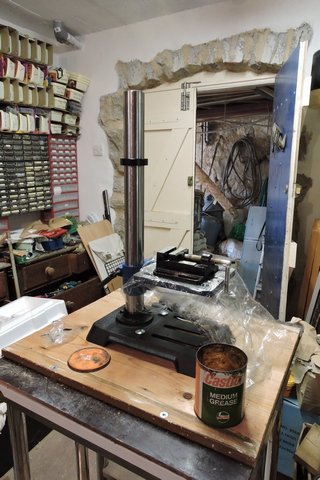
Throughout I made sure to use grease on moving parts so that corrosion will not be a problem on any bare metal.
The last job was to fit the actual machine to the top of the mounting tube and tighten everything into place.
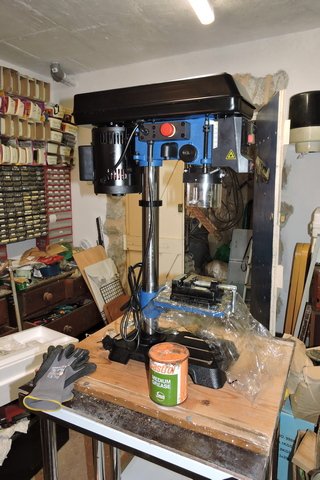
Assembly was not difficult, providing you followed the instructions. Being a German made Scheppach, the instructions and diagrams are thorough and well written.
I am going to need to get a couple of things though. Being mobile, I will need to plug the drill press into wall or floor sockets, so I will need a small extension lead. Next time I am in town I will go to Volat to look for a stainless steel cleet, so there is somewhere to hang a few metres of cable, when it is not in use.
The machine comes with a short length of cable and a Schuko plug, with the actual on/off switch above the drill chuck. However I think I will put an “Emergency Off” button somewhere close to hand on the worktop, just in case…

As for my next project, I would like to try making some tenon joints, so watch this space.
Decision made
Irrigation has continued all this week.
Morning and evening I can be found with a watering can, doing spot irrigation on shrubs and trees, or using the underground irrigation to try and keep things alive.
I had the hosepipe out in the citrus orchard at the start of the week, to try and soak around the various trees. The next morning there was a little improvement. However by Thursday, all the leaves were curled again.
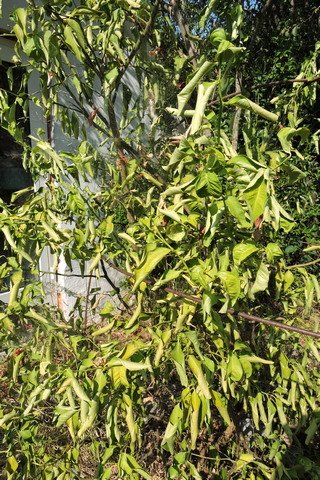
The orchard soil is a clay loam with at least 30% by volume of limestone, so it has a high pH. I don’t know how deep the soil is, but I suspect it’s not very. At one end, bedrock protrudes from the ground. At the other, the soil is held back into a terrace by a stone wall, over a metre tall.
Over multiple years, I have tried and failed to improve the quality of the soil. I have added organic material, kept weeds in check, mulched around the 12 trees in the 100 square metres area and regularly irrigated.
However this year has been the worst ever for the trees suffering stress with the heat, and that is even after I used summer shade netting on all of them.
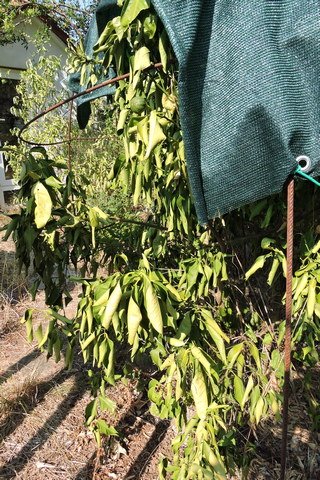
So far just this week, I have used more than 1,500 litres of water, just trying to keep the trees alive and I am failing.
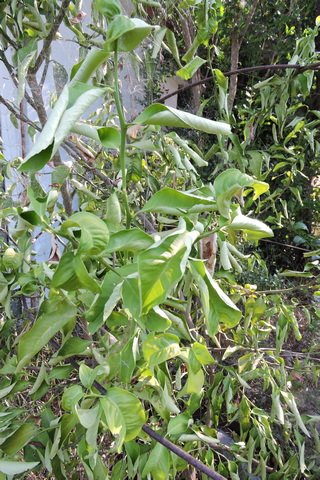
When I looked at the Citrus on Thursday, fruit are turning black and dropping off. This is the defence mechanism of the trees, when they are under severe stress.
Out of the twelve trees, there are three which whilst suffering, are not as bad as the others.
This orchard also has rain water from three roofs fed underground into slow release pipes, as well as the underground irrigation. But when there is no rain, there is nothing for the roof gutters to catch.
I have watched other people in the village plant trees and seen them grow tall and strong. All the while, mine after ten years are no more than large bushes.
This spring, after our cool and wet winter, they were all covered with blossom. Most of it set but now the young fruit have died and fallen.
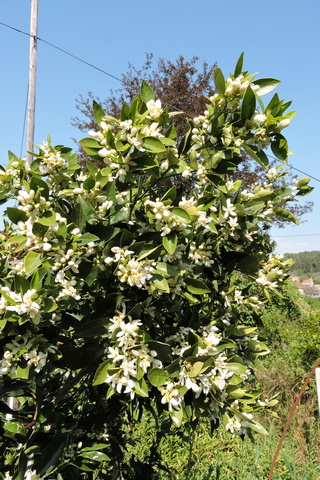
As climate breakdown continues and the experts predict that this weather pattern of extreme summer heat, short mild wet winters, but a lack of other precipitation is likely to be the new normal and will probably intensify, I have made the decision to leave some of the trees to their own devices.
I have always known that almost all my soils were worked out, devoid of nutrients and shallow. It would take dozens of truck loads of soil to try and improve them, but when the subsoil is so poor, to what end?
This decision means that some of the trees are not going to survive, but I think I planted them too late.
Neighbours who planted citrus trees 30 or more years ago, when the climate was very different, have large, mature trees which have developed strong, deep root systems and they fruit well.
In the last ten years, the climate has altered so much, that young trees cannot get a firm foothold and when combined with all the other factors, sadly some will not survive.
I don’t like doing it, but 1,000 litres a week, for just one orchard is simply not sustainable. Perhaps just a few trees, which seem to have found a water source, is all I can expect to keep.
Not everything I do is a success. Sometimes despite the money, resources, time and effort, things just do not work out as I had planned! NCG