Is it a mean or an average?
This week: Is it a mean or an average?; As the nights draw in;
I was once described as a “wordsmith”, which I definitely took as a compliment, especially as it came from a very senior officer.
This person was a master of put downs too.
I was with him at a public event when we were approached by a journalist who was wearing a rather garish sports jacket and flannels. My colleagues welcome was “Good to see you again B…. I see you choose your clothes as carefully a you choose your words.” The man was left speechless and we walked on.
I take the same care every week with this blog, knowing that it is read across the world, by people for whom English, and specifically British English is not their first language.
Languages convey not just ideas, but also concepts and some concepts simply do not translate well, so I write with care.
There is then the issue of automatic translation.
On many programmes now you just have to right click on some text and then select translate to **, to have the text presented to you in your chosen language.
I am often asked to correct an automatic translation to correct English, not always an easy task though, because you have to get into the head of the writer. So when I chose my words, I think very hard about using the right word, the right expression to convey the meaning I want.
The week has been extremely hot again and I recorded an actual temperature in the shade on Friday of 36.9°C, but because of the humidity and wind, the temperature feel was 42°C. Once again, this is just not normal for the last week of August.
I have to say that I have not enjoyed this summer, one little bit.
I used to enjoy heat, so whether it is after effects of my hospitalisation last year, or an effect of the medication I am still taking, I don’t know. What I do know is that I find the heat and humidity tiring and debilitating.
Once it gets to 9 or 10 am, I retreat inside, where there is still some air movement, caused by the open windows and doors and differential pressure on the different sides of my buildings.
Several times this week, the indoor temperature at night has been over 30°C, which makes comfortable sleep difficult. As the walls of my home, heated throughout the day, radiate the heat at night, I have difficulty in reducing the temperatures to any meaningful degree.
Is it a mean or an average?
We had a tiny amount of rain on Tuesday this week. I recorded 1 mm or 1 litre per m² falling, which because of the ambient heat, was very quickly evaporated away.
Apart from that the days have been hot with temperatures over 32°C most days.
As high pressure settled over the island on Friday, I recorded an actual temperature of 36.9°C with a feel of 42°C. This was just plain unpleasant!
I had been thinking about how to present data from my weather station, in an understandable way, to show how the climate here in Dol has changed in the time I have been here.
So on several afternoon’s I was doing analysis of the vast amounts of data I have accumulated.
I’m not and have never pretended to be a statistician, rather I work on the principle that if I can understand something, then blog readers probably will too.
I tend to use “average” to describe the lines on graphs and charts, but there is a difference between an “average” and a “mean”, even though in general discussion only average is used, even when the figures are a ‘mean’!
An average is a central value, which summarises a set of numbers.
A “mean” is defined as the result of adding all the numbers in a dataset together and then dividing the result by the total number of values you added together.
So something more precise, but when people think of an average, it is usually a “mean” they are thinking of.
Once data is in a spreadsheet, it is easy to manipulate those data points to produce a graph or chart. Thinking about the pronouncement from the EU Copernicus earth observation programme, that the past five years have been the hottest ever recorded, I looked at that data.
From looking at the data set, I could see that recent years have been hotter, but I was not prepared for what the chart showed.
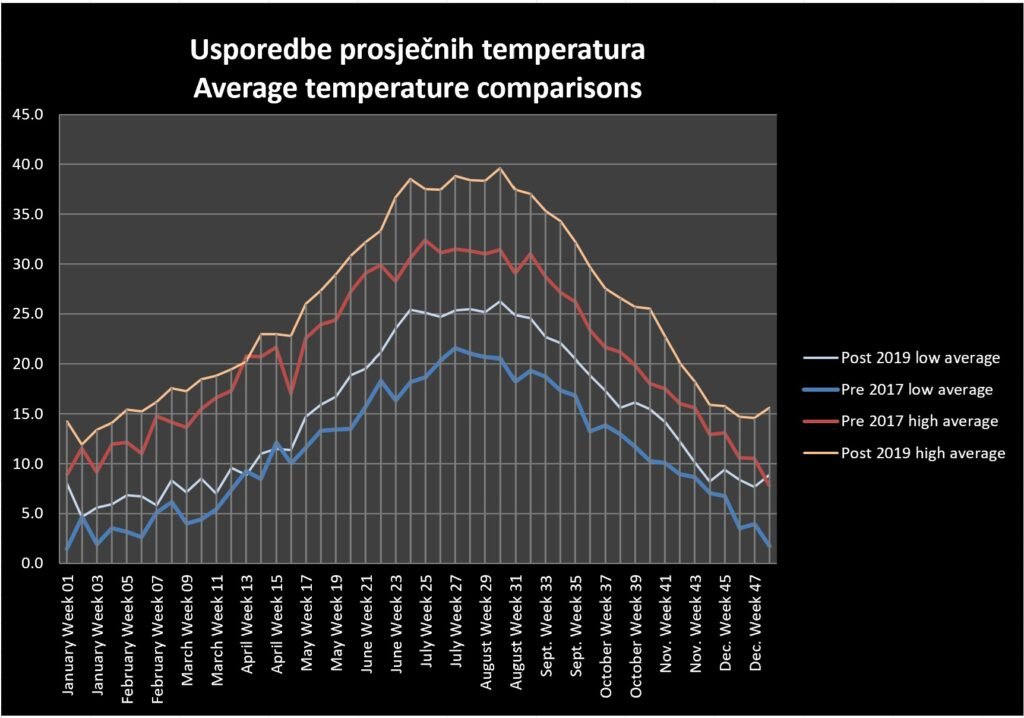
This is just one location on the island and there will be places which are both hotter and cooler. However you can see the dark red and dark blue lines from more than 10 years ago are all less or significantly less that the mean for the past six years.
Residents and visitors have been complaining about the heat this summer – so it isn’t just me – and the new word “Coolcation” has entered the English language .
This is used to describe people NOT going to traditional Mediterranean resorts in high summer, to avoid the heat.
Whilst some part of the world have benefited from this, it has also opened up once again, the discussion about sustainable tourism.
Mass tourism to the far north (Arctic etc) is just as unsustainable as the largest cruise liners disgorging 5,000 visitors all at once on places like Venice and Dubrovnik.
The total precipitation for the two periods was within 10mm of being the same. However there are differences in when the precipitation is received, but they are not especially marked.
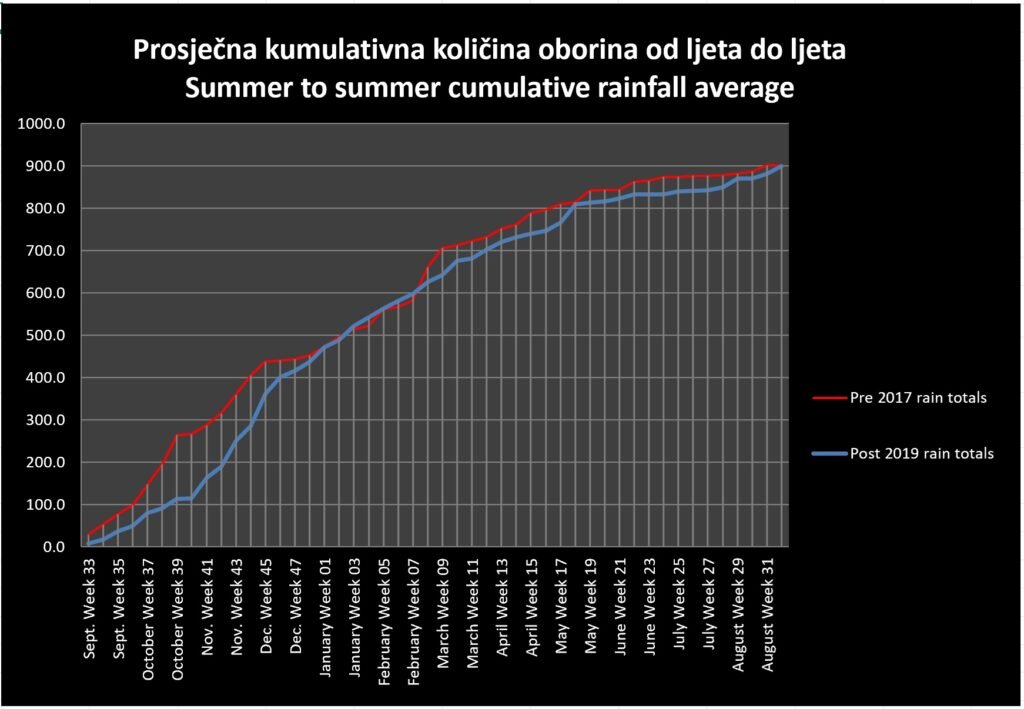
So my thoughts that overall precipitation is now lower is not borne out by the statistics.
I have often had a “gut feeling” that our years are hotter and with less rainfall than when I moved to Dol, but seldom have I seen such a stark set of figures to support my feeling.
As the nights draw in
I really do not like August, for a number of reasons, one of which is the shortening days and lengthening nights.
It also reminds me of the return to school after the summer holidays, which I always hated!
In June and July, it is light enough to see by, until well after 21:00. This week our sunset time is 19:30 and by 20:00 you need a torch for any outside expedition.
So when I turned my outside light on, which usually lights the bridge linking my two buildings and it failed to work, I was mildly miffed, but not too unhappy.
Taking the cover off the light, I removed and changed the light bulb. Switching the light on, the bulb failed to illuminate.
At that point I realised it may not have been a bulb problem, but just to be sure, I made up a bulb tester.
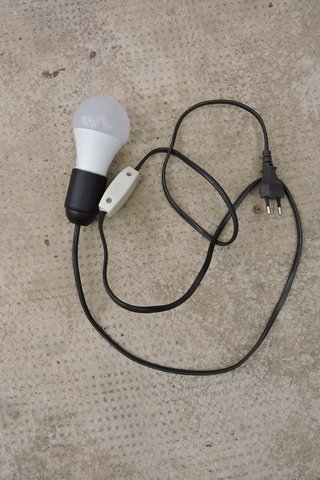
Its a simple device with a plug, some wire, a switch and a bulb holder. I can’t really think why I haven’t needed one before?
Plugging the tester in, both bulbs worked, so the problem is not with the bulbs… By which time it was too hot outside, so I left the job for a day.
I decided to do the circuit testing, from easiest to hardest, so started by removing the outside lamp unit.
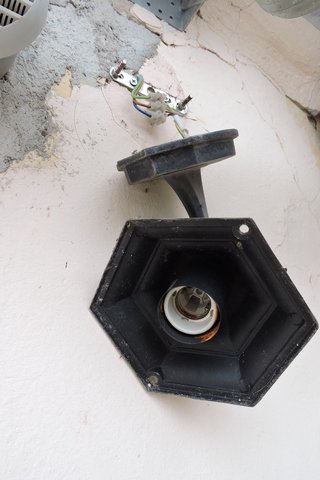
Everything was secure, no loose wires, in fact I was surprised how well I had installed the unit, probably some ten years ago now.
Turning the power on at the switch did not bring power to the lamp, so I removed the indoor light switch cover.
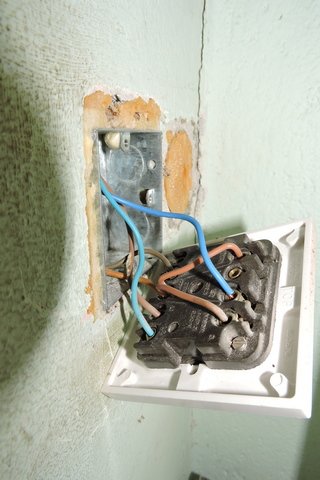
This is a three gang, two way switch, meaning I can turn three lamps on at one switch and all of them can be turned on and off from different locations.
I do recall that this installation was difficult because there was just a single conduit feed inside the wall and I didn’t want to break the plaster to install more.
When I tested all the circuits at the switch, power was present and the switches all worked.
So that means that the problem is somewhere in the wiring loom between the switch and the outside lamp.
This is a complicated corner because the main consumer unit is above the switch and not only that, I put Styrofoam sheets on the ceiling as winter insulation.
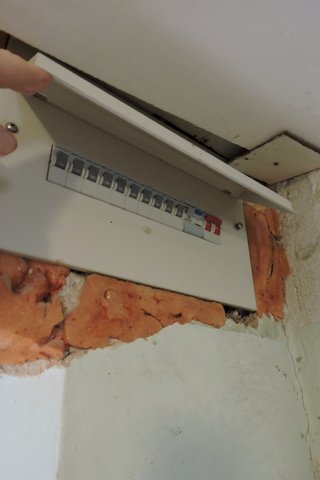
This means that there is going to be a lot of dismantling to be done, to get at the wiring, which also runs under the roof tiles for a short distance, to see where the problem is.
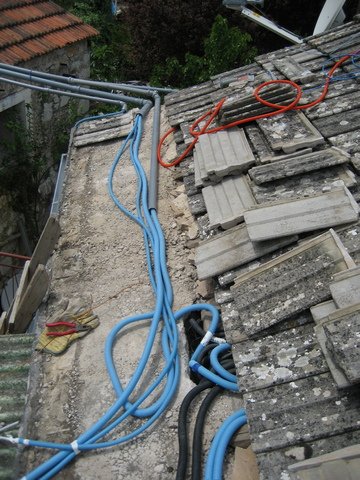
Before I do any of that, I am going to go through my photographs to see if I can see anything pertinent. I installed the new consumer unit, removing the old and decrepit fuse board because of electrical safety, as one of my first projects when I moved in.
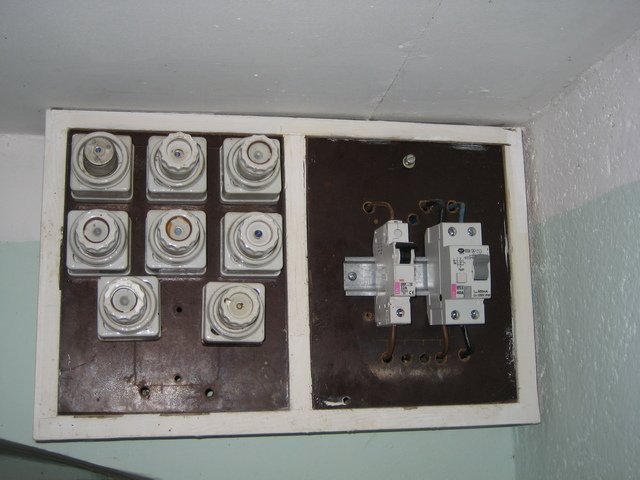
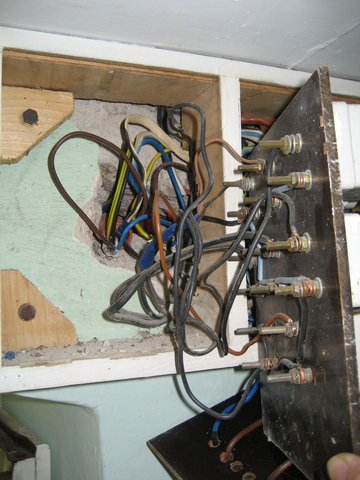
I have a few more weeks before I really need to have a working outside lamp, so have time on my side.
When you own old property, there are always jobs which need doing… NCG